Wednesday, June 24, 2020

Thames (NZ): Update on Totara Memorial Park Cemetery

Miracles do happen! Wonderful news today that tree maintenance has taken place at Totara Memorial Park Cemetery, with more to come!


ARROW A: 2PUBL-001-0001 to 0020
The plots at the northern end of the 'old' section were looking sad and neglected 18 months ago. Low lying tree branches and a problem of leaf drop meant the headstones were difficult to read and maintain.
    Thanks to TCDC contractors the trees have been trimmed and vicinity cleared. This area is down a small hill, but now the plots once again are a part of the cemetery. 
     The photo below left was taken January 2019, and below right June 2020. The Hetherington plot top left, can now be seen and all in this section can be kept clean from now on.


Before & After Hetherington Plot 2PUBL-001-0001

ARROW B: TIZARD BLOCK
Another transformation, that was necessary to stop damage potentially caused by broken branches. Trees may look great in a cemetery but left unchecked they often damage many of the plots.
     The before and after photographs of the Tizard Block are below.


CHALLENGE TIME
Remember to try and find time to visit your ancestors' graves and clear a few leaves or two!!! If they happen to be at Thames - thank-you for helping us to remember those interred in our local cemeteries.

A touch of colour at the southern end of the 'old' section of Totara Memorial Park Cemetery.
The plot (2PUBL-027-0004) of Lydia Vermont Snelgar nee Dufty.

Tuesday, June 23, 2020

Thames (NZ): Music in schools - another of John Grigg's achievements

Introduction
The Thames Goldfield was opened 1 August 1867, within months private then public schools were established.  A comprehensive curriculum was offered including singing instruction using a method known as Tonic Sol Fa.
     Tonic sol-fa (or Tonic sol-fah) is a pedagogical technique for teaching sight-singing, invented by Sarah Ann Glover (1785–1867) of Norwich, England and popularised by John Curwen who adapted it from a number of earlier musical systems. 
     A photograph republished in the Thames Star newspaper in 1937, aimed to record for future time an important aspect of Thames education. Special thanks to Dick for alerting me to the report.

Thames Star 20 August 1937 courtesy of PapersPast.
[I will try to get a better copy out of the newspaper]

The background to the photograph
Interestingly, Mr Grigg is not in the photograph, because he was the photographer - yet another skill and hobby of John Grigg's.

"OLD PHOTOGRAPH. NAMES OF INDIVIDUALS. EARLY THAMES TEACHERS. 
     The great interest being taken in the early history of Thames prompted the “Star” to inquire for particulars regarding the photograph which is published again to-day.
     As a result, we are able to publish the following interesting description, and thus preserve for the future one incident in Thames history which may easily have slipped into oblivion: —
     The photograph was taken at the old Kauaeranga School, which stood on the site of the present High School.
     It was taken one Saturday morning about 1887, by the late Mr John Grigg, who had a place of business in Pollen Street in premises now occupied by Edwin Brown and Co. Mr Grigg was employed by the Auckland Education Board as instructor in singing for the Thames primary schools, and on Saturdays, from 12 to 1, he gave teachers of the Thames schools instruction in the Tonic Sol-fa Method. It was after one of these lessons that the photo was taken.
     The teachers assembled every Saturday morning in the old Kauaeranga Boys’ School from 9 until 1 pm. Mr Horatio Phillips, the principal, gave instructions in school method and in drawing; then Mr W J Barlow, drill instructor, took over the teachers for physical and military drill. Mr Grigg followed with one hour for singing.
     The teachers are, reading from extreme left:—Fred Lough, pupil teacher, at back Wm. Elgar Johns, p.t., James Christie, assistant-master Waiokaraka school, later headmaster of Waiotahi Greek school, and Bayfield school, Auckland; Albert Gerring, assistant master, Kauaeranga Boys’ School; others in back row, Miss Wilson, Miss J. Paterson; then in centre, Mr. Horatio Phillips, headmaster of the Kauaeranga School,-, -, -, Miss Crowther, Miss Wolff, W. Hammond, p.t. (back row; in front, A. Chas. Hill, p.t., W. Simmonds, p.t., W. H. V. Hall, Mr. Taylor, assistant teacher at Parawai School. Middle row, from left: Miss Kate Fletcher, -, -, Miss F. Fletcher, Miss Gibb, Miss Ashman, Miss K. Mulvany, Miss Ryan, Mrs. H. Phillips, Miss Colebrook. Front row, from left: Miss Truscott, Miss A. Hall, Miss Murrish, Miss Brown, —, Miss Gibbons, Miss McQuade, Miss M. McLaughlin, —, Miss Goad. 
     One in the back row may be Miss Jessie Heighway. Among the males, Messrs. Jas. Christie, A. Gerring, H Phillips, M. W. Simmonds and Taylor are deceased. Messrs. F. Lough, W. E. Johns. W. Hammond, Chas. Hill, W. H. V. Hall are still living."
Thames Star 20 August 1937 courtesy of PapersPast.

Education at The Thames
Aucklanders were envious of the number of schools on the Thames Goldfield and the attendance records - Often questioning why Thames got so much assistance. The answer being that from the time the town was opened for pakeha settlement in August 1867, one of the things that was pushed by all residents was education. The schools introduced innovative teaching methods, and valued the education of both boys and girls. The examples in the passages above demonstrate the commitment shown by our early teachers to continually strive for better methods, which included attending Saturday lessons to advance their teaching skills.
     You can read more about education on the goldfield in Thames Goldfield Schools by A Barker.

The Tonic Sol Fa System at The Thames
The following are snippets from our local newspapers on the system:
  • 1874 September 23 Thames Star:  When Mr J Sheehan MHR, Provisional Secretary visited the Waiotahi Creek School, the pupils under the guidance of Mr Brown sang several songs - having been taught in the tonic sol fa system. "Mr Sheehan said that if all schools under the Act were as well disciplined and so thoroughly organised, the money was well spent."
  • 1874 September 24 Thames Star: Board of Education appointed John Grigg to teach vocal music in Thames Schools for six months - payment rate 150 Pounds per annum. "The Auckland Board of Education have adopted the Tonic Sol Fa method of instruction in vocal music in the public schools." [Remember schools in Thames such as Waiotahi Creek were already using the method]
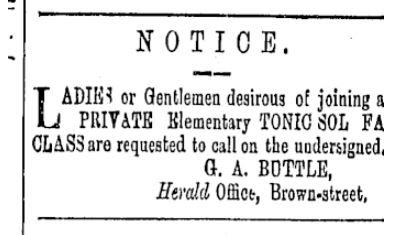
  • 1879 May 14 Thames Advertiser:  Mr G A Buttle advertised private lessons for adults wanting to learn elementary Tonic Sol Fa.
                          
  • 1880 January 21 Thames Star: Mr John Grigg advertised night classes for instruction in singing of the Tonic Sol Fa Method. He planned to amalgamate his Teachers' and Private Classes - Ladies and Gentlemen would be charged a small fee.
  • 1880 June 16 Thames Star: Thames High School appointed new Music and singing teachers - not everyone thought the Tonic Sol Fa method was achieving success and the Board was in a agreement to return to the old notation system.
  • 1880 June 21 Thames Advertiser: The paper contained a long 'letter to the editor' from Mr John Grigg, who had taken exception to the comments made by the Thames High School Board regarding methods of singing instruction.  Grigg talked of the merits of using both methods, and the advantages of each. It was never the intention to do away with notation method, but due to time constraints the Tonic Sol Fa Method could and did produce great results. He also quoted the success of the system in many English schools.
  • 1887 December 16 Thames Advertiser: Mr John Grigg resigned as itinerant teacher of music in Thames schools, having had the role for ten years. Teaching staff if the Tararu School who on this occasion thanked Grigg, and he praised their proficiency in the Tonic Sol Fa Method.
My Own New Zealand Home - written by Mr John Grigg of Thames
The Song above is written using the Tonic Sol Fa Method.

An interesting time, new methods versus old, or a mix of all systems. What is impressive, is that these old Thamesites continually explored new methods in education and kept up-to-date concerning developments around the world. 
     Thamesites were indebted to Mr John Grigg, (who died 100 years ago), there is no doubt he provided invaluable music instruction to hundreds of children during his ten year plus tenure as itinerant school music teacher at the Thames.

Sunday, June 21, 2020

Thames (NZ): The John Grigg story continued

The previous post covered the lead up to the 100 year commemoration of John Grigg's death at the Thames. On Saturday 20 June 2020, a few of us took up the open invitation to join the Grigg descendants to celebrate the life of this special Thamesite.
John Grigg and his third wife Mary Jane (Henderson)
M Finlay collection

     We were immediately welcomed by the family group. John Grigg was known as a family man, a christian and he would have been proud to see his descendants gathered at his 'old' town.
     The programme started with morning tea & registration - the morning events taking place at the Baptist Church in Mary Street, the church where John Grigg was a founding member.

My Own New Zealand Home
Following family introductions it was only fitting that the highlight was talking about, then singing Grigg's "My Own New Zealand Home". Well known for decades as the unofficial anthem of New Zealand - in particular the song that was sung in schools and at events in the Upper North Island.

M Finlay collection

Presentations
Various family members gave presentations on John Grigg's life. Noting the newspapers were full of advertisements as John's business developed from furniture importer to his beloved music shop - he even spent time as an undertaker. A prolific writer of original music, a music teacher who taught in the district schools, and was a member / leader of many choirs and musical events. 
     Alastair from Stargazers (at Whitianga) was present and gave an overview of Grigg's involvement in astronomy and his remarkable achievements.
     There are even craters on the far side of the moon, named after Thamesite John Grigg!

Where were Grigg's observatories located?
The question was asked regarding the location of John Grigg's observatories. The first was located in Pollen Street behind his shop / house and the second was at his residence near the corner of Pahau and Queen Streets.
 

     The location of the Grigg's first observatory (built about 1884 behind his Pollen Street shop) is exactly marked on an 1889 street map. Today this site is st the back of the Thames 100% shop premises. The co-ordinates are marked below, top left.

     Around 1894, Grigg's residence moved to the south-east corner of Queen and Pahau Streets. The residence faced Queen Street, just north of the Karaka Creek. A snip from a William Price's 1910s photograph appears to clearly show Grigg's observatory on the rear of his section. In the snip below this is the white building in the centre. The 'dome' identifiable, against the white washing at the rear.
Caption: Overlooking Thames township. 
Ref: 1/2-001541-G. Alexander Turnbull Library, Wellington, New Zealand.

Memorial window at the Baptist Church
The Baptist Church at Thames has large stained glass windows that commemorate the founding members - John Grigg's commemorative window is on the western wall.

Unveiling of John Grigg's restored grave
After lunch the family travelled to the Shortland Cemetery. Undeterred by the rain and limited access, young and old made their way to the plot on the lower section of the cemetery extension off Danby Street.
 

     A dedicatory prayer and thanksgiving for John Grigg's life was given. Followed by the reading of two bible passages, then a final eulogy was delivered.
     Next came the unveiling of the new plaque / headstone. All the hard work and planning was worth it, the family proud that John Grigg FRAS (1838-1920) will continue to be remembered at his beloved Thames.


CHALLENGE
I must say I was envious to see these Grigg descendants gathered to remember an early Thamesite. 
     How many times have you contemplated caring for, or repairing an ancestor's grave? And not followed through. 
     How many times have you thought a family get-together was needed to commemorate a special anniversary? And not organised it. Thought it was all too hard? 
     Well how about we take the challenge and do something to remember our Thames ancestors, and reconnect with other living descendants!

Further reading on Grigg's astronomy:
Exploring the History of New Zealand Astronomy by Wayne Orchiston 2016.

Thursday, June 18, 2020

Thames (NZ): John Grigg remembered 100 years after his death

In previous posts we have looked at the life and achievements of amazing Thamesite John Grigg.

In more recent times, it was noted that Grigg's grave had been restored.


Now comes the news that this weekend descendants of John Grigg are commemorating the 100th anniversary of his death, 20 June 1920 at the Thames.

Stuff.co.nz have a report on Mr John Grigg of the Thames (1838-1920).
"Behind a piano shop on Pollen St in Thames, John Grigg built an observatory that would later be used to locate his first comet.
     Two more comet discoveries followed, and after more than 100 years, Grigg's astronomical achievements with the stars are still being acknowledged on Earth.
     Grigg was born in London on June 4, 1838 and moved to Thames in 1867, at the height of the gold rush.
     He relocated his observatory - equipped with a resolving roof - to his home in Queen St, where he discovered his first comet in July, 1902." For full report click here.
 
A memorial church service is being held in the Thames Baptist Church - Commencing at 10am on Saturday, June 20, the gathering is open to all interested.

AUCKLAND STAR, VOLUME LI, ISSUE 147, 21 JUNE 1920

Background Reading on Mr John Grigg:
Biography at Te Ara.
Meteors over Thames.
John Grigg, and the genesis of cometary astronomy in New Zealand, by Wayne Orchiston.
Matthew Grigg, son of John Grigg.

Tuesday, June 16, 2020

Thames (NZ): Shortland Cemetery - the aging process

Thamesites chose interesting sites for the Tararu Cemetery and Shortland Cemetery. While 'chose' is not exactly the right word, as it was the generosity of local iwi, that led to the cemeteries location.

How has Shortland Cemetery stood the test of time? 
Well, sadly a walk around the lower extension off Danby Street is not a pleasant one.
     The aerial below (via Google maps) gives the appearance of order and a well kept cemetery. But! Do you see the trees? They regularly break, leaving twigs to major branches over graves, and lets not start on the leaf fall! Leaves build up on the graves, and soon become a medium for weed growth.
     At present the lower section of the cemetery is dry, normally in winter the ground is sodden and boggy. 


What has this meant to the overall state of the graves?
Large numbers of graves are overgrown, covered with leaves and branches. Headstones have broken, toppled over, lettering lost / taken. The ground subsides and moves, resulting in broken masonry.

 
Graves at Shortland cemetery.

     While the images above are depressing (there are many in a worse state), special thanks to descendants and a few helpers who are clearing some of the graves. Your work has not gone unnoticed - thank-you for caring for our old Thamesites!
     I hope to share some news in the near future about how more folk can help, to restore some dignity to this old cemetery.

View from the top of Shortland Cemetery 1910s. The cemetery and graves intact. 
Although it appears even then the trees are causing problems!

A special grave - Then & Now
The style of headstone and grave surround at Shortland varies from simple to ornate. One can only imagine what the plot looked like in the earlier days. By chance today I stumbled across an old grave photo from 1876 - the grave of Margaret Edith Lush. 

"Margaret Edith was born in 1859 and was the daughter of the Anglican minister Vicesimus Lush and his wife Blanche. Tragically, Margaret Edith died from Scarlet Fever on 22 April 1876. While the death of a child was not unusual during the Victorian era, this does not mean that the loss was not felt greatly by parents and family members. In his journal, Margaret Edith’s father wrote openly of his grief as he struggled to come to terms with the loss of his daughter, ‘”The child is not dead but sleepth” This has been the burden of my thought ever since 9 oclock when my dear dear dearest Edith Fell asleep.’" 

Changes have been made to the plot, with a concrete surround placed around the grave and a plaque for another person placed within the plot surround.
     The large cross that stood above the inscription base, has been broken over time and now lies flat at the base of the original structure. A good and safe solution!

 
Left: 1876 view of Edith Lush's grave at Shortland Cemetery.
Photo Source: Collection of Ewelme Cottage, Heritage New Zealand Historic Pouhere Taonga
Right: 2019 view of Edith Lush's Grave.
Photo: Graeme Pearce / Findagrave

Shortland Cemetery Friends
While the dream is to have a 'Friends of Shortland Cemetery' Group up and running, there were several other species happily enjoying the peace of the cemetery grounds today. Large groups of pigeons were busy looking for food, but the stars of the show were the Fantails / pīwakawaka, busily hopping from one grave to another.

 
The Fantail sits on the headstone of John Lange (Past Prime Minister David Lange's grandfather).

Take the Challenge
Take a break and visit one of Thames' historic cemeteries, the view from all three is spectacular.

Thursday, June 11, 2020

Thames (NZ): Dalmatian Family History Resources

1. Have you explored the information in Kura Heritage Collections Online recently?

Several documents relate to settlers from Yugoslavia who came to the Thames area, in particular to the Kauaeranga Valley. The men worked in the bush and looked for gum; with some becoming well known farmers in the valley. Below are some links for information on these families:
  • Kauaeranga Valley & Devcich Brothers is available to view online and download. The importance of the kauri logging is covered, along with invoices and paybook details for Dalmatian settlers such as the Devcich's. Mr Simun Devcich "came to New Zealand from Yugoslavia in 1902 and at the age of 17 years commenced work on the gumfields of the Coromandel Peninsula." Page 27.

There are 88 items from the Dalmatian Genealogical & Historical Society, from which you are sure to find a lot more information on families who lived (even for a short period) in the Thames - Kauaeranga Valley area.

2. Another source for names of settlers from Yugoslavia / Dalmatia is the 1917 Aliens Register. 
Notice of the Registration of Aliens Act (below), where "every alien is required to make application for registration in the prescribed form not later than 1st December, 1917. Alien means a person of either sex not less than fifteen years of ages who is not a British subject either by birth of by naturalization in New Zealand." Auckland War Memorial Museum.

Thames Area Names in 1917 Aliens Register
Source: New Zealand Register of Aliens 1917 : in 2 volumes, pages 120-124
Government Printing Office Publishing, Wellington, New Zealand Pub. Year: 1917


Surname, Firstname: Birthplace, Occupation, Address
Aab, Jacob: Russia, Cook, Kauaeranga Valley
Ah Lom, : China, Market Gardener, Parawai
Angjelinovic, Simun: Dalmatia, Gum digger, Tairua
Barkarich, Kuzina: Dalmatia, Gum digger, Gumtown
Barbalid, Josephine: Austria, Domestic Duties, Kauaeranga Valley
Barbalid, Tudor Nikola: Austria, Farmer, Kauaeranga Valley
Barbarich, Roko: Dalmatia, Gum digger, Hikuai
Barbarich, Thomas: Dalmatia, Farm labourer, Turua
Barbarich, Tony: Dalmatia, Drainer, Turua
Bartularich, Tane: Dalmatia, Gum digger, Tairua
Bartulovich, George: Dalmatia, Gum digger, Hikuai
Bartulovich, Jozepk: Dalmatia, Gum digger, Hikuai
Bartulovich, Toni: Dalmatia, Gum digger, Tairua
Basmalinavich, Albert: Dalmatia, Drainer, Turua
Bilcich, Toma: Dalmatia, Gum digger, Hikuai
Bitech, Petar: Dalmatia, Gum digger, Puriri
Blank, Albert: Germany, Fisherman, Mackay St, Thames
Blumenthal, Kurt George: Germany, Farm labourer, Pipiroa
Boehmert, Alfred: Germany, Gum digger, Gumtown
Bonefacid, Nikola: Austria, Farmer, Kauaeranga Valley
Boravich, Thomas: Dalmatia, Drainer, Turua
Botica, Mijo: Dalmatia, Gum digger, Hikuai
Botica, Visko: Dalmatia, Gum digger, Hikuai
Bratlie, Ingvaed Johan Hanson: Norway, Farmer, Ngatea
Burich, Miho: Dalmatia, Farmer, Hikutaia
Ching, Wong: China, Market Gardener, Totara, Kopu
Claxton, Sarah Ann: United States, Domestic Duties, Parawai
Curin, John M: Dalmatia, Farmer, Kauaeranga Valley
Dazench, Ivan: Dalmatia, Sawyer, Gumtown
Devcich, Antonio: Austria, Domestic Duties, Puriri
Devcich, Grgo: Dalmatia, Dairy-farm hand, Kauaeranga Valley
Devcich, Matya: Dalmatia, Domestic Duties, Puriri
Devcich, Simun: Dalmatia, Farmer and Storekeeper, Puriri
Divich, Mate: Dalmatia, Gum digger, Hikuai
Edwardson, Anthony: Norway, Fisherman, Whangamata
Erceg, Anton: Dalmatia, Storekeeper, Gumtown
Erceg, Jozip: Dalmatia, Storekeeper, Gumtown
Erceg, Nicholas: Dalmatia, Labourer, Kauaeranga Valley
Exelsona, Olaf: Sweden, Old age pensioner, Tairua
Fagerstrom, Ernis Gabrial: Denmark, Farm assistant, Waitakaruru
Fisher, William: Holland, , Tararu Creek, Thames
Fog, Ah: China, Market Gardener, Warahoe
Foo, Ah: China, Market Gardener, Warahoe
Frantovich, Johan: Dalmatia, Farm labourer, Waitakaruri
Garmay, Fred: Dalmatia, Drainer, Turua
Garmay, Tony: Dalmatia, Drainer, Turua
Gin, Lee: China, Market Gardener, Warahoe
Gisler, Francis R: Switzerland, Dairy farmer, Turua
Godfrey, Olufine: Norway, Domestic Duties, Franklin St, Thames
Granville, John: Denmark, Fruitgrower, Kauaeranga Valley
Gundlock, Agnes Magdlene: Norway, Farm assistant, Puru, Waiomio
Gundlock, Johannes: Norway, Farm assistant, Puru, Waiomio
Hangard, Einar Thorvald Hofgard: Denmark, Butter factory assistant, Kopu
Hansen, John Emut: Denmark, Orchardist, Parawai
Hansen, Louise Elizabeth: Germany, Domestic Duties, Parawai
Hollstun, John August: Finland, Farm worker, Turua
Huljish, Andrew: Dalmatia, Gum digger, Hikuai
Huljish, Steave: Dalmatia, Gum digger, Hikuai
Janovich, Jack: Dalmatia, Gum digger, Puketui
Johns, Joseph Peter: France, , Tairua
Johnson, Charles: Denmark, Gardener, Sandes St, Thames
Jonquin, Paul: South America, , Puriri
Jordan, Rudolph: Switzerland, Chauffeur & Gardener, Thames
Juricevich, Ivan: Dalmatia, Gum digger, Gumtown
Juricevich, Nikola: Dalmatia, Gum digger, Gumtown
Kavich, Ivan: Dalmatia, Gum digger, Hikuai
Kavich, Jaze: Dalmatia, Gum digger, Hikuai
Knap, John: Germany, Dairy farmer, Pipiroa
Kon, Ah: China, Market Gardener, Warahoe
Koslich, Savo: Dalmatia, Gum digger, Tairua
Kriskoivich, Balri: Kosia, Gum digger, Hikuai
Kriskoivich, Mate: Kosia, Gum digger, Hikuai
Kristovich, Toni: Croatia, Gum digger, Hikuai
Lee, Thomas: Norway, Gold miner, Tapu Creek, Tapu
Long, Ah: China, Market Gardener, Warahoe
Lopes, Ermine Jildo: Cape Verde Island, Labourer, Tairua
Lovrich, Mateo: Austria, Farm assistant, Kauaeranga Valley
Marelich, Toni: Dalmatia, Farm labourer, Puketui
Martin, Robert: Russia, House builder, Turua
Matijasevich, Andria: Dalmatia, Gum digger, Hikuai
Matijasevich, Ivan: Dalmatia, Gum digger, Hikuai
Matyoswich, Peter: Dalmatia, Gum digger, Hikuai
Meyenberg, Sophia Margaretta Anne: Germany, , Tairua
Mialjevic, Jose: Dalmatia, Gum digger, Hikuai
Mijaljevic, Stipe: Dalmatia, Gum digger, Tairua
Mog, Wong: China, Market Gardener, Totara, Kopu
Mood, George Henly: Germany, Old age pensioner, Matatoki
Nicholson, Alex: Sweden, Gum digger, Gumtown
Nielsen, Hans Valdemar: Denmark, Buttermaker, Kopu
Olsen, Fredrick: Sweden, Dairy farmer, Turua
Ostarich, Toni: Dalmatia, Gum digger, Hikuai
Pearson, Peter: Denmark, Dredge Engineer, Sealey St, Thames
Penseler, William: Germany, Fruit farmer, Thames Coast
Penzholz, Auguste: Germany, Domestic Duties, Pipiroa
Piacun, Dinko: Dalmatia, Gum digger, Gumtown
Piacun, Mate: Dalmatia, Farm labourer, Turua
Piacun, Tome: Dalmatia, Gum digger, Gumtown
Pinchs, Martin: Switzerland, Dairy farm Hand, Turua
Pizarun, Mirk: Dalmatia, Gum digger, Gumtown
Pizarun, Toni: Dalmatia, Gum digger, Gumtown
Printise, Nicholas: Chile, Gum digger, Tairua
Radich, Jack: Dalmatia, Gum digger, Puketui
Radovancich, Bartol: Dalmatia, Sawyer, Gumtown
Radovanich, Ivan: Dalmatia, Gum digger, Hikuai
Radovanovich, Antony: Dalmatia, Gum digger, Rangiou
Radovanovich, Frank: Dalmatia, Gum digger, Gumtown
Rolansen, Axel: Norway, Gold miner, Puketui
Ross, Charles: Sweden, Bushman, Hikuai
Ross, John: America, Old age pensioner, Omotui
Rouse, John: Sweden, Bushman, Whangamata
Ruzich, A J K: Austria, Gold miner, Waiomio
Sahor, Tony: Dalmatia, Gum digger, Utamahitai
Sale, Marin: Dalmatia, Labourer, Kauaeranga Valley
Sardelich, Frank: Austria, Farm labourer, Wharepoa
Schmidt, Joseph: Denmark, Farmer, Matatoki
Schwarz, Hermann : Germany, Dairy farmer, Pipiroa
Slavich, Steve: Dalmatia, Gum digger, Hikuai
Slavich, Toni: Dalmatia, Gum digger, Hikuai
Sokolich, Andria: Croatia, Gum digger, Hikuai
Sokolich, Ivan: Croatia, Labourer, Kauaeranga Valley
Sokolich, Ivan: Croatia, Gum digger, Hikuai
Sokolich, Philip: Croatia, Gum digger, Hikuai
Solari, John: Italy, Pensioner, Hikuai
Song, George J: New Caledonia, Bushman, Te Mata, Tapu
Sorensen, Simes Anton: Norway, , Turua
Stewart, Annie: Sweden, Domestic Duties, Turua
Sukovich, August: Croatia, Gum digger, Hikuai
Swanson, Alexander: Sweden, Bridge worker, Ngatea
Sylvia, Antonio: Portugal, , Puketui
Tvankovich, George: Dalmatia, Gum digger, Gumtown
Vicira, Manual: Portugal, Stamperman, Nevesville
Vinjovich, Mick: Dalmatia, Gum digger, Hikuai
Vitali, Domenick: Dalmatia, Store Assistant, Gumtown
Vitali, Michael D: Dalmatia, Storekeeper, Gumtown
Vujnovic, Toni: Dalmatia, Gum digger, Hikuai
Zimmerman, August: Germany, Farm labourer, Pipiroa

NB. Spelling variants in translation and transcription efforts. List includes many nationalities.

1908. Kauaeranga Valley, during the logging years, and where many Dalmatian families settled.
Colourised version courtesy of MyHeritage.com
Original Source: Auckland Libraries Heritage Collections AWNS-19080611-5-1

Saturday, June 6, 2020

Thames (NZ): Thames Second Look in Colour - Pārāwai.

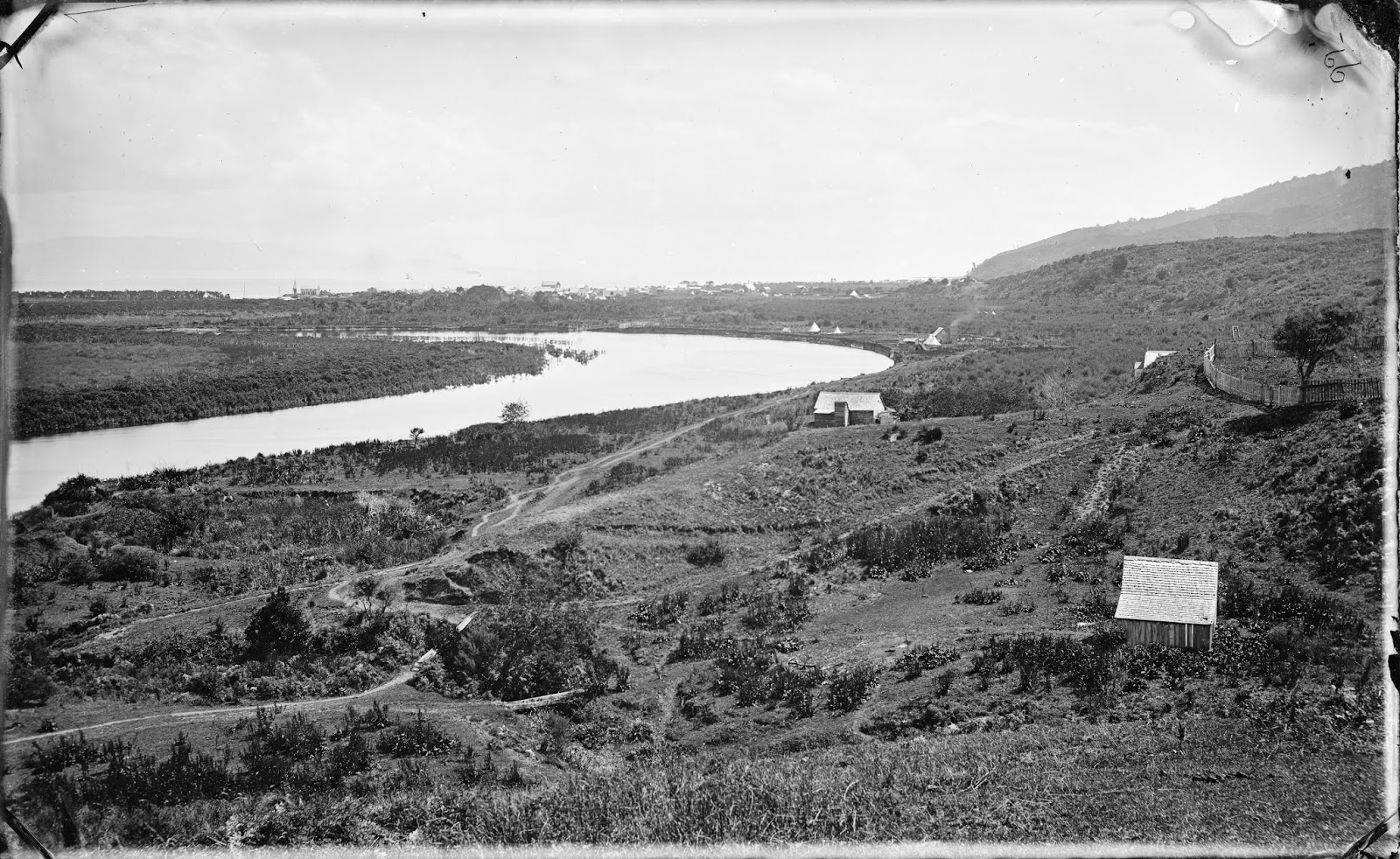
Another favourite view is a D M Beere photograph looking over Pārāwai towards Shortland Town.
     Taken around 1868, the foreground focuses on the area around the Hauraki Mission Station that was located in the Mount Sea Road - Herewaka area of Pārāwai.

Photo Right: View from Hauraki Mission Station at Parawai, towards Shortland. Ref: 1/2-096132-G. Alexander Turnbull Library,  Wellington, New Zealand. /records/23172220

Imagine living in this area around 1867, alongside tangata whenua and missionaries. Nestled by the meandering Kauaeranga River, the inhabitants were witness to the development and chaos surrounding Shortland Town and Grahamstown.

A Second Look in Colour
What did you see in the photograph above? A few houses, bush tracks and buildings in the distance?

  • Take a 'second look' and spy the Duke of Edinburgh Hotel adjacent to the Shortland Landing - present day this is the area of the Shortland Wharf at the seaward end of Grey Street, Thames. The hotel is the two storied building right of centre in the snip below. There is also a large boat anchored at the landing, with several other masts to the left of centre.


  • Moving right in the original D M Beere photograph to the bend in the Kauaeranga River - present day this is the area of Banks Street and Parawai Road. There is a small settlement, with a boat anchored alongside the bank. Abode construction ranges from punga huts, to tents, to small wooden huts, to a large house with an outside chimney billowing smoke. Maybe the residents had been boiling water for wash day, as their long clothes line is loaded with washing!


  • The next snip is of a well established area at Pārāwai - the Hauraki Mission Station (HMS) grounds and Church. A well fenced area, with the mission house out of view to the right. The church bell is clearly visible top centre, and on the flat below is the first HMS Church built 1863. The HMS had been established at Puriri in 1833 and moved to Pārāwai in 1837.  Present day this is the area around Mount Sea Road and Herewaka Street.

  • Given the previous blog post dealt with early footpaths at nearby Shortland and Grahamstown, it would be remiss not to look at walkways and tracks along the Kauaeranga River area. The 'second look' in colour shows the tracks leading from further up the Kauaeranga River back to Pārāwai. The paths look in relatively good condition, although narrow, adequate for foot and horse traffic. Gully areas have what looks like logs, forming footbridges.


Wow, what a difference colour makes! Remembering the warning from our previous colourised post, the colour has been automatically generated and has not been refined to correct possible errors. Regardless, its still worth a 'second look'.

Then & Now 1868 & 2019
Photo sources:
Top: Photo Right: View from Hauraki Mission Station at Parawai, towards Shortland. Ref: 1/2-096132-G. Alexander Turnbull Library,  Wellington, New Zealand. /records/23172220 Colourised courtesy of MyHeritage.
Lower: Aerial view from Google Maps.

Background Reading:
Hauraki Mission Station (Puriri and Parawai Sites), by David Wilton, Treasury Journal 2008.

Friday, June 5, 2020

Thames (NZ): Asphalt arrives at the Thames Goldfield

Excitement at The Thames 12 October 1877, the first asphalt footpath was completed! Whats the big deal you may ask, and was it really the first? (Note variant spelling in the newspapers as 'asphalte')

THAMES ADVERTISER, 22 OCTOBER 1877

The first footpaths at Shortland Town and Grahamstown
   Mathias Whitehead came to Shortland Town in 1868 and described the state of the roads and footpaths at the time of the 1917 reunion. Whitehead recalled the town as the "City" of Board of Works [sic], "when a substantial wooden footpath was laid down" because most walkways were impassable in the early years on the goldfield.

 
 Left: Whitehead's report on the state of the footpaths. Thames Star 1 August 1917.  Right: 'Boardwalks' surrounded shops at the Thames Museum during 'Heritage Rescue' filming 2015. These have since been removed.

Above: This is the area of Shortland Town that Mathias Whitehead was talking about. Spot the wooden boxing used to separate road from footpath and to act as a drain. In some cases this was enough to keep the footpath in good condition, as the shop owners could afford it, a wooden board walk was added.

      Any alterations to the footpaths had to be approved by the local Highway Board. In April 1872, Mr Ehrenfried applied to the Waiotahi District Highway Board to build a wooden footpath in front of the Grahamstown Hotel.
      While initially a success, within a few years the wooden footpaths began to deteriorate. The cause varied from children deliberately vandalising the footpaths to mobs of cattle being driven through the town straying on them. One of the most significant was water damage from floods and high tides. Hence they soon became unsafe and a danger to pedestrians.

The Asphalt solution!
     There are reports in the newspapers around New Zealand in the 1860s about footpath construction and various methods of compressing rock, to the use of tar or asphalt.
     There are no mentions of 'asphalt' in the Thames Guardian newspaper 1871-1872.
From 1874 the Thames Star (Evening Star) and Thames Advertiser are online at Paperspast, below is a summary of the development and use of asphalt footpaths:
  •  1874 24 Sept Thames Advertiser: The Union Bank of Australia (corner Queen & Albert Streets) were building a new brick premises and planned to have an asphalt footpath.
  • 1876 13 March Thames Star: The Borough asphalters were busy outside the Academy of Music and Pacific Hotel in Brown Street.
Thames Star 13 March 1876.
  • 1877 12 October Thames Advertiser: The report stated the first asphalte footpath at the Thames was completed in front of the Bank of New Zealand in Brown Street.
  • 1877 26 June Thames Star: The Thames Borough Council suggested that the repairs to the footpath outside the Theatre Royal Hotel in Williamson Street, be constructed in asphalt.
  • 1878 16 January Thames Star: It was not just footpaths that were being made in asphalt, the floor of the new fire engine shed at Shortland was being laid with this product.
  • 1878 28 January Thames Star:  News that the Queens Hotel (corner of Albert & Queen Streets), and the Pacific Hotel (corner Brown & Albert Street) were both planning to put down asphalt footpaths outside their premises. In one month March-April 258 yards of asphalt were laid outside the hotel.
  • 1878 6 April Thames Star: It was noted by a writer named 'Perambulator' that it was pleasing to see townsfolk showing faith in the town by making upgrades such as laying on water and gas, plus laying down asphalt footpaths.
  • 1878 9 April Thames Star: The new footpaths were taking a bit of getting used to, painters were warned about the use of ladders in the newly laid asphalt paths as they were prone to leaving holes especially on hot days. 
  • 1878 19 April Thames Star: All the asphalt work around the town, meant that the Council was busy trying to procure further supplies of stone or gravel - Tenders were called for 200 cubic yards.
  • 1878 31 May Thames Advertiser: Problems were encountered with the new method of laying footpaths, the join between old and new was prone to causing problems. "An instance occurred last night. The respected incumbent of St George's was escorting one of the members of his choir home, when opposite the Queen's Hotel he was forced to his knees, and compelled to maintain a recumbent attitude for a few seconds, through the unevenness of the new path where it joins old."
What were the costs of the footpaths?
    As at March 1878 the average cost of footpaths per running foot was: Asphalt 3s 4d; common filling with water tables 2s 4d; common filling without water tables 1s 6d. A report to the local Council recommended that water tables and a footpath be completed the length of Pollen Street from Shortland to Grahamstown.  The cost 937 Pounds 8 shillings. For a 3 foot wide asphalt path laid along side the tables the total cost would be 1406 Pounds 16 shillings.
     As the months passed, more side streets were planned to have footpath upgrades. The costs were often under debate, Mr Soury for instance claimed 12 October 1878, that he could lay the new asphalt footpaths at a greatly reduced rate.
     The local cricket club saved some money by getting a loan of the asphalt roller to roll the cricket green for the new season. (Thames Star 27 August 1880)
     Ongoing costs ensued over the following years. Topdressing of the original footpath was needed as part of the maintenance routine, plus repairs to sections of the path due usually to sinking and subsidence.

Initially it was exciting to get a date for the first asphalt footpath at the Thames - 12 October 1877. However there appears to have been without question several sections of footpath laid during 1874 to 1876, along with the use of asphalt for floors in some premises. In the following decades, asphalt tennis courts make the headlines on numerous occasions! Regardless, the use of the asphalt process / material was a great improvement over the initial paths tread by the first settlers on the Thames Goldfield.

Above: Boardwalk sections can be seen top right outside the St George's Hall at the northern end of Pollen Street, along with boardwalk crossings to several hotels and businesses on the eastern side of the street.

Above: early 1900s view of Bank of New Zealand (centre right), the reported area where the first asphalt footpath was laid in 1877.
Below: Then & Now. The Pacific (left out of view) & Wharf Hotel on the left c1880, corner Albert and Brown Streets. The area where asphalt was reported to be laid in 1876. 
 

Monday, June 1, 2020

Thames (NZ): Thames Name on Queen's Birthday Honours List 2020

On a separate page, you will find the list of Thamesites who have received a Royal Honour, while recognising it is probably far from complete. The aim is to acknowledge all people who have had a connection to Thames and then gone on to receive an award in the New Years or Queens Birthday Honours List.

Today 1 June 2020, Gwenyth Wright from Waiotahi, Thames is an honour recipient. If You know of any others, please let me know. I am investigating one other, but need to confirm its the right person!!!

GWENYTH MARY WRIGHT:

For services to women and the community

"Ms Gwenyth Wright established the Thames Women’s Loan Fund (WLF) in 2003, providing community-led microcredit to women without charging interest.

The Thames WLF is a mutual microcredit scheme for women who need help to establish a small business, study, or stabilise their financial situation. Ms Wright has been a Trustee of the Fund since its inception, and it continues to grow to this day. Prior to establishing the Thames WLF, she was a founding Trustee of the Wellington WLF from 1992 to 2002. She established the Organic Strategy Group in 2003, which contributes to a greater understanding of organic horticulture in the community. She has organised earth building workshops and an organic farming intern scheme for youth established in 2009. She worked with the Thames Coromandel District Council in 2015 to arrange land for natural burials, a project that has seen the establishment of a flourishing natural burial garden visible from the main road south of Thames. Ms Wright edited the Women in Agriculture newsletter from 1982 to 1992." Source: https://dpmc.govt.nz/honours/lists/qb2020-qsm#wrightgw

Many of you will also know that Gwenyth has been involved in many local groups, including being a supporter an interviewer for the Thames Oral History Group (part of The Coromandel Heritage Trust).

In November 2019, Gwenyth was awarded a medal for being one of the 15 Kiwibank Local Heroes for 2020.

Information on The Thames Women's Loan fund is available online. Snippet from web-page below.


Gwenyth also features in a book released in 2019 by Frances Denz - The change makers: a collection of stories of those who brought about change.

Congratulations Gwenyth.