Saturday, March 7, 2015

Thames (NZ): THe House of Hotunui revisited 1880

I have often looked at the photo featured here and just acknowledged that the House of Hotunui was in the distance but that there was nothing else to see apart from the front gardens. High resolution scans have meant that this is far from the truth and yet again a wealth of information can be found on a SECOND LOOK.

The Description given for the photo reads: "View from Shortland (also known as Thames), looking towards Parawai, showing Colonel Wirope Hoterini Taipari's meeting house, Hotonui (completed 1878) at right centre. Photograph taken in 1880 by Daniel Manders Beere."
View from Shortland, looking towards Parawai. Beere, Daniel Manders, 1833-1909 :Negatives of New Zealand and Australia. Ref: 1/2-096137-G. Alexander Turnbull Library, Wellington, New Zealand. http://natlib.govt.nz/records/23047558
 
In the foreground of the photo is the area that today is housing and occupied by Thames South School. In this photo is this the large garden area associated with the old Kauaeranga Pa, a place where the reported Kumera and other crops would have been grown.
 
HOUSING: To the left of the photo is what looks like a shack, on closer look there is even an outhouse like structure, but given this looks like a garden then maybe it is just an implement shed?. Note that the fence completely surrounds this garden area.
Moving closer to the meeting house, the hills in the background of Parawai are a marked contrast to that of Shortland and Grahamstown - which would at this time be ravaged by the effects of mining. The land appears farmed and in set paddocks. No shortage of fencing here!  Also the houses are substantial compared to the miners huts in the northerly parts of the Thames. The rich folk lived at Parawai!!!
 
HOUSE of HOTUNUI: A closer look at the meeting house, located near the corner of Bowen (later Rolleston Street) and Fenton Street. Later in the 1920s this would be moved to the Auckland War Memorial Museum, where it resides today and it is the centrepiece of their Maori cultural display area.


Friday, March 6, 2015

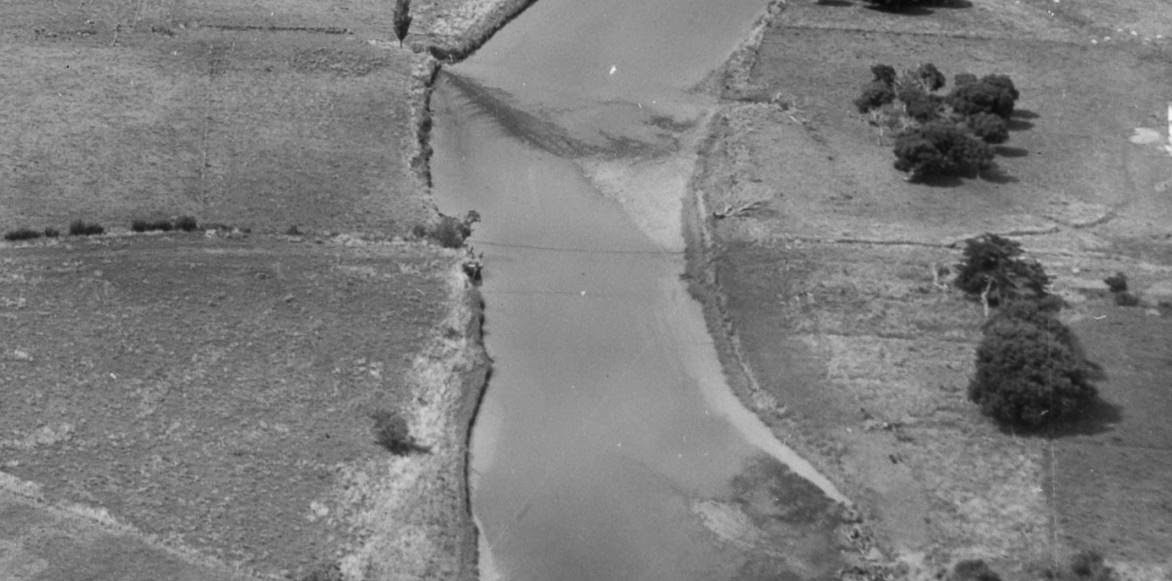
Thames (NZ): Kauaeranga Swing Bridge


The bridge has been gone for many years, but for many the memory remains.

Thames (NZ): Canner's Shortland Hotel - Then & Now

The Shortland Hotel features often in posts, and no apology is forthcoming for that! The Shortland end of town is on the whole forgotten in photographic history of The Thames compared to the abundance of photos for the Grahamstown end of town. That end of town has a close range of hills that makes photography so much easier!!

There are many pluses to this photo of the Shortland end of Pollen Street. On this day a parade is taking place, children eagerly follow along with the procession. In the distance on the right is the shop of Coakley's (later on the corner of Pollen and Willoughby Streets). The Shortland Hotel in this view does not have the later second floor verandah.  Those hotel watchers will see its a great view of that angled front door we have looked at previously.
 THEN AND NOW VIEWS

Thursday, March 5, 2015

Thames (NZ): Second Look - 1900 Government Buildings and surrounds

There is lots to see close-up on our SECOND LOOK at the Government buildings. With this photo I was not so concerned with the building, as we have looked at that in a previous post. The hills behind are the gold in this photo, as we can stop and look at the houses perched (often precariously) on the hills above Grahamstown.
Post office and courthouse, Grahamstown, taken ca 1870s by an unidentified photographer.
Source: Post office, Grahamstown. Ellings, E E (Mr), fl 1976 :Photographs of Thames. Ref: 1/2-065410-F. Alexander Turnbull Library, Wellington, New Zealand. http://natlib.govt.nz/records/23106729
 
ROADING: Well not a lot can be said about the state of these roads, they are merely rubble with great ponds of water. Maybe work is in progress and the footpath and roads are in a state of construction! In the view below "Armed Constabulary" can be seen at the left end of the Government building. At least the fence is complete - there's nothing Thamesites liked more that good fencing around their properties.

 HOUSING: The hills above the courthouse are dotted with cottages, in the Upper Albert Street area and further up the back of Broad Street - Princess Street area. Look at the houses, they are not all the same, although at first look you may be fooled. Roof lines are single gable, double gable and hip roof. A good reference book for house identification is "Old New Zealand Houses 1800 - 1940" by Jeremy Salmond. House plans in this book show the larger cottages would typically have a lounge and kitchen on one side and two bedrooms on the other side of the front door. While the small ones here would typically be two rooms, with two windows and door at front. One room would be for sleeping the other for kitchen/living.


In the photo above, the houses on the lower levels are of a slightly different construction. The windows are of different sizes. Is that an outhouse to the left of the top house?The more substantial building on the flat, at the front of this photo is likely to be a hotel or shop.

MINING: The hills are scarred at the left of the photo along the Waiotahi spur, back towards Upper Albert Street. Ground has been cleared and the land explored. Brave souls have built there houses and the very top of the hill.
 

Thames (NZ): Sporting Greats - 1920 Rugby Peace Cup

Over the decades there have been times when Thames Sporting teams and individuals have matched with the best. If you have one to share, please let me know.

One such moment was when the Thames Rugby team won the Peace Cup off Hamilton in 1920. There were 1500 people at Steele Park in Hamilton to witness Thames (dressed in their blue and black colours) defeat Hamilton 11 points to 8.

There is a full match report in the Thames Star 20 September 1920. The report detailed how Winder,  who was playing for Thames injured his arm but went back on - luckily he did as he marked and kicked the winning goal!.

The Thames team were: G Buchan, Winder, Jamieson, Prussing, Burrett, Garry (replaced by Fleming), Alexander, Smith, Strange, Brownlee, Wilton, Stewart, Lomas and Blackie.
(Positions on right)

Moments like this were not quickly forgotten. In 1976, Cliff Barker of Thames remembered the great day and the wonderful years of football that followed. (Thames Star 29 June 1976)

“Mr Barker recalled some of his experiences as a team member at his recent ninetieth birthday celebrations. He joined the team for its second Peace Cup game, the game after Thames won the cup from Hamilton in the first successful challenge for it. Even though he didn’t play…Mr Barker remembers what happened…Hamilton was under hard pressure from Thames when suddenly a Hamilton forward managed to grab the ball and relieve the attack by kicking for the line.  No Thames player was there, except…J Winder was on the sideline having his injured leg rubbed by a medical attendant.  And then…"Winder thrust the medical chappie aside…and at the same moment got a nod from the referee as he rushed on to the field and joined the play.  He took up a bouncing ball and with masterly precision thumped a dropkick dead-centre between the posts.” Thames had won its first Peace Cup.

Cliff then joined the side aged 36. And they had more wins. His captain was “Circus Hayward, who was 38, known as the granddad of the team. They travelled to Auckland on the Wakatere, which was an adventure in itself. In one game Mickie Lomas scored three tries – the team formed a circle around Lomas and sang, “For He’s A Jolly Good Fellow.”
The reporter asked Cliff how the team practised? He replied, “Quite a few of us were fishermen, working three and four days away from Thames…To the best of my memory you went for a gallop around the streets when you could, but I can never remember having group training sessions…You were picked for the reps, and the rest was up to you.”

Cliff Barker's son Doug, had a cartoon published with the article and in later years others concerning the Peace Cup also appeared in the local paper. For many long years it was always the dream to bring the cup back to Thames.
A cartoon depicting Winder making the winning kick to claim the Peace Cup in 1920
By D Barker, Thames


1970s cartoon that appeared in The Thames Star
By D Barker, Thames
-------------------------------------------------------------------------------------------------
In the Thames Star 10 September 1928 there was a photo of the 1922 team that won the Peace Cup
Back Row L to R: W Pollock, M Phillips, J Winder, C Abraham, G Pollock, A O'Hara, L Stewart, G Buchan (line umpire).
Middle Row L to R: J Benney, J Pratt, R Smith, R Rhodes (chairman Thames Rigby Union), M Hayward (Capt.), A Lomas, A Winder.
Front Row L to R: A Morrissey, H Donnelly, L McRae, Hayward (Mascot), A McCollum, G Buchanan.

Sunday, March 1, 2015

Thames (NZ): Racecourse area 1965

The Racecourse at Parawai in 1965 is the feature today. The land north of the course, and east of the Kauaeranga River, has undergone major changes over the decades. Land has been subdivided and now there is a school, hospital rest-home, and major housing developments.

You can see why this was an important area for early Thames, it had multiple gardens, and was used extensively by many sports. Running events, rugby, cricket and hockey were regularly played on the paddocks south of Barrett Road.
 
Thames Racecourse. Whites Aviation Ltd :Photographs. Ref: WA-63640-F. Alexander Turnbull Library, Wellington, New Zealand. http://natlib.govt.nz/records/23174107
 
On second look, there a few areas of interest.
 
At the end of Barrett Road the evidence can be seen of the old Kauaeranga Bridge, that was the only bridge into town. for many decades pre 1920s


The land north of the Parawai Racecourse is only partially developed. Yet to come is the Parawai School and stopbank developments.
 
 
Below is the Totara area. There is housing along Tony's Avenue, but many more houses to come in the following years.
 
See the Totara Cemetery in the distance, which has expanded considerably over the decades. 


Thames (NZ): Miscellaneous photos from the 1927 Thames Star Part two

A few more photographs from the 1927 Thames Star Newspaper.
 Messrs JOHNSTON BROS' Hair Establishment - Ladies Room
 
 TEACHERS OF THAMES - under the control of Mr Horatio Phillips
Back Row (standing): Messrs W Johns, A Gerring, F Lough. J Christie; Misses Best, Hill, Mulvahill, Wilson, Patterson, Mr H Phillips (Principal of Class), Misses Gillespie, Stilwell, Lamb, Crowther, Wolfe, Messrs W Hammond, C Hall, W Simmonds, W Hall, A Taylor.
Second Row: Misses Fletcher, Blakeley, Cleave, F Fletcher, Mulvany, Gibb, M Ashman, Ashman, Ryan, Mrs H Phillips, Miss F Colebrook
Sitting: Misses Truscott, Murray, Murrish, Brown, Akers, Gibbons, McQuade, McLoughlin, Greenslade, Coad.

THAMES RUGBY in 1887 - WANDERER'S TEAM
Back Row: R POTTS, P LEITH, H BROWNLEE, David STEWART, J DARE, G CLEAVE
Second Row: Darby O'BRIEN, J HINDMAN, T MCCOLLUM, J (Duggie) MCGREGOR (Capt), R MCCOLLUM, Harry MCLACHLAN, Dan SAUNDERS
Third Row: [names missing from page of paper]

Thames (NZ): Miscellaneous photos from the 1927 Thames Star Part one

Maybe it was the cost that prevented the newspaper publishing more local photographs, but there was never ever any shortage of photographs of movie stars in most editions. Here are a selection of photographs in the 1927 Thames Star newspaper.
Baillie Street, Thames
 
A VIEW OF BLOCK 27 IN THE EARLY DAYS
 
PROGRESS OF NEW HAURAKI BRIDGE

PROGRESS OF NEW HAURAKI BRIDGE
It is expected this link on the main highway to Auckland will be completed in March.

Friday, February 27, 2015

Thames NZ: Kurunui Bay 1868 - a Second Look

A lovely photo used on many early postcards, taken from different angles, but essentially the Kurunui Hotel features as the dominant subject. Maybe because of that I skim over it and think of it only as the hotel photo...but there is much more to see on a second look.
Thames Goldfield, NZ.
Source: J Vedder-Price Collection

Where to start? Lets look first at the hotel. There is some type of window covering upstairs and the windows upstairs facing south are open. Two of the lower centre windows have a net like curtain seemingly knotted or pulled together. Note the small building attached at the back, was this the first part of hotel and then the main two storey section was built. We know that the hotel was opened by 1868 and later burnt down in 1876.

Known Publicans: George M(A)CDONALD: 1868, Henry CARROLL: 1868, Samuel STRAW: 1869, Mr SLACK 1869, Robert Hugh THOMAS: 1870-76, Michael MCMAHON 1875, and  Chas MORROW 1875.

Note the most distinguishing feature of a hotel - the large lamp over the main front door. A hotel could lose its license for not having this lit. Also see that the front or main door is always traditionally on an angle. Quite possible that the building that was built on the area known as the beach, could have had water lap up to it in a storm. The large pole - is it a flagpole? To alert new visitors to the bay that a hotel and accommodation was on offer.
 
Residential houses and shop. The houses are fenced off. The traditional quick Thames miner's cottage design. Two windows at front and the door in the centre. The shop on the right probably has some living accommodation out the back, sadly the signage can not be read.

Shops and equipment or more housing. Given the front location, one could speculate these are shops or workmen's cottages. There is a lot of wood and wagons nearby. A large mining structure is underway at back right. The roof appears to be a wooden shingle. The small top window is interesting on the right-hand building, possibly an upstairs sleeping area.
 
The hill. Now to the interesting part, what is happening on the hill!! Lots of tunnels and evidence of diggings literally dumped outside. A step structure can be seen on the centre left going to the main digging area. What of the long chute, would it be water, tailings?
 
A Photo full of things to look at and ponder. More of interest where is everyone?
All at work or gone to town?

Thursday, February 26, 2015

Thames (NZ): Special Visits - Rob & Thea Muldoon

SPECIAL VISITS: In 1978 Prime Minister Robert and Mrs Thea Muldoon were in Thames, as guest of honours for the March Thames Hospital Nurses' Graduation. On 24 February 2015, Dame Thea Muldoon died. More information at: http://goo.gl/UBm8Fg

Right Honourable Robert Muldoon and Thea Muldoon at Thames for the nurses' graduation March 1978. The photograph is taken in the Nurses' Dining Room where the graduations were normally held.
Source: Thames Hospital Pictorial CD, by Waikato Health Board. 
 
Cartoon drawings by Doug Barker of Thames in 1975 - of Rob Muldoon and Bill Rowlings. They appeared on the front page of the Sunday News Newspaper in 1975. (exact date not recorded)
 Source: A Barker Collection